

Discover the untouched beauty of Isaan with Eat Walk Talk Tour.
Planning for a Northeastern Thailand (Isaan) Trip: The Ultimate Guide to Culture, Nature & Food 🌾✨
If you have already navigated the vibrant nightlife of Bangkok, basked on the tropical islands of the south, and explored the misty temples of Chiang Mai, you may find yourself asking: Where is the authentic, untouched heart of Thailand? The definitive answer lies in the vast, culturally rich plateau of Northeastern Thailand, universally known to locals as Isaan (อีสาน). Bordered by the mighty Mekong River to the north and east, and Cambodia to the south, Isaan represents the agricultural backbone of the kingdom. Here, ancient Khmer temple sanctuaries, world-class spicy cuisine, captivating silk-weaving villages, and warm-hearted rural hospitality all converge into an unforgettable travel experience.
Planning an expedition across Isaan requires a more thoughtful approach than standard tourist routes in Central or Southern Thailand. The distances between provinces are substantial, English is less widely spoken in rural communities, and the rhythm of daily life is dictated by seasonal rice farming and age-old festivals. However, the rewards for curious and respectful travelers are extraordinary. This detailed guide covers the essential provinces, iconic attractions, legendary foods, regional logistics, and high-impact travel FAQs to help you design a seamless Northeastern Thailand itinerary. Before you depart the capital, you can also explore our advice on What to Do While on a Bangkok Business Trip.
💡 Essential Isaan Travel Summary: The premier window to visit Northeastern Thailand is the cool, dry season from November to February. The region spans 20 provinces, anchored by "The Big Four" transport hubs: Nakhon Ratchasima (Korat), Khon Kaen, Udon Thani, and Ubon Ratchathani. Renting a car or utilizing comfortable regional trains and domestic flights offers the greatest freedom to explore off-the-beaten-path wonders.
Why Explore Isaan? The Essence of Authentic Thai Culture
Isaan possesses a distinct cultural identity shaped by geography, language, and centuries of close kinship with neighboring Laos and Cambodia. Over 20 million people call this region home, many speaking local dialects such as Phasa Isaan (closely related to Lao) or Northern Khmer in the southern provinces. Life across the plateau proceeds at a peaceful, deliberate pace centered around community solidarity and the philosophy of Sanuk (finding joy in everyday moments).
Music and storytelling are central to Isaan's soul. The irresistible, driving tempo of Mor Lam folk music—powered by the haunting, reed-pipe melodies of the bamboo Khaen (แคน) and the twang of the plucked Phin lute—animates temple fairs and village celebrations throughout the year. The geographical diversity is equally staggering: from sandstone cliffs overlooking the Mekong River to mystical prehistoric caves, sacred volcanic peaks, and endless green rice paddies stretching toward distant horizons.
Top Provinces and Must-Visit Attractions in Northeastern Thailand
While exploring all 20 provinces would require months, focusing on key geographic clusters ensures a deeply rewarding journey. Here are the premier destinations that should anchor your itinerary:
1. Nakhon Ratchasima (Korat): The Majestic Gateway to Isaan
Located just a 3-hour drive northeast of Bangkok, Nakhon Ratchasima (commonly called Korat) is the largest province in Thailand and the natural gateway to the plateau. The provincial capital reveres Thao Suranari (Ya Mo), an 18th-century Siamese heroine who led citizens to repel invading forces; her central monument is a bustling pilgrimage site adorned with floral garlands and traditional Korat dance performances.
Just one hour north of the city stands Prasat Hin Phimai (อุทยานประวัติศาสตร์พิมาย), one of the most magnificent and well-preserved Khmer sanctuaries in Southeast Asia. Built during the 11th and 12th centuries, Phimai was constructed along the ancient Royal Khmer Highway linking directly to Angkor. Architectural historians note that Phimai's elegant cruciform layout and intricately carved sandstone lintels directly inspired the design of Cambodia's world-famous Angkor Wat.
2. Buriram & Surin: The Southern Khmer Heritage Trail
Traveling south along the lower Isaan corridor reveals Thailand's most dramatic Khmer temple architectures:
- Phanom Rung Historical Park (อุทยานประวัติศาสตร์พนมรุ้ง): Perched dramatically atop the rim of an extinct volcano in Buriram, this 10th-century Hindu sanctuary dedicated to Lord Shiva is a pinnacle of Khmer engineering. A sweeping 160-meter processional walkway flanked by five-headed Naga balustrades leads up to the central sandstone sanctuary. Four times each year, the rising and setting sun aligns perfectly through all 15 sanctuary doorways in a breathtaking astronomical marvel.
- Prasat Mueang Tam (ปราสาทเมืองต่ำ): Nestled on the plains just below Phanom Rung, this elegant 10th-century temple features serene L-shaped reflection pools adorned with stone Naga serpents, offering a peaceful, uncrowded atmosphere.
- Surin Elephant Village & Silk Weaving: Surin is globally celebrated for its deep historical bond with Asian elephants in Baan Ta Klang, and for the world-renowned Baan Tha Sawang weaving village, where master artisans produce 100-ply gold brocade silk once presented to international heads of state at APEC summits.
3. Udon Thani: The Miracle of the Red Lotus Sea
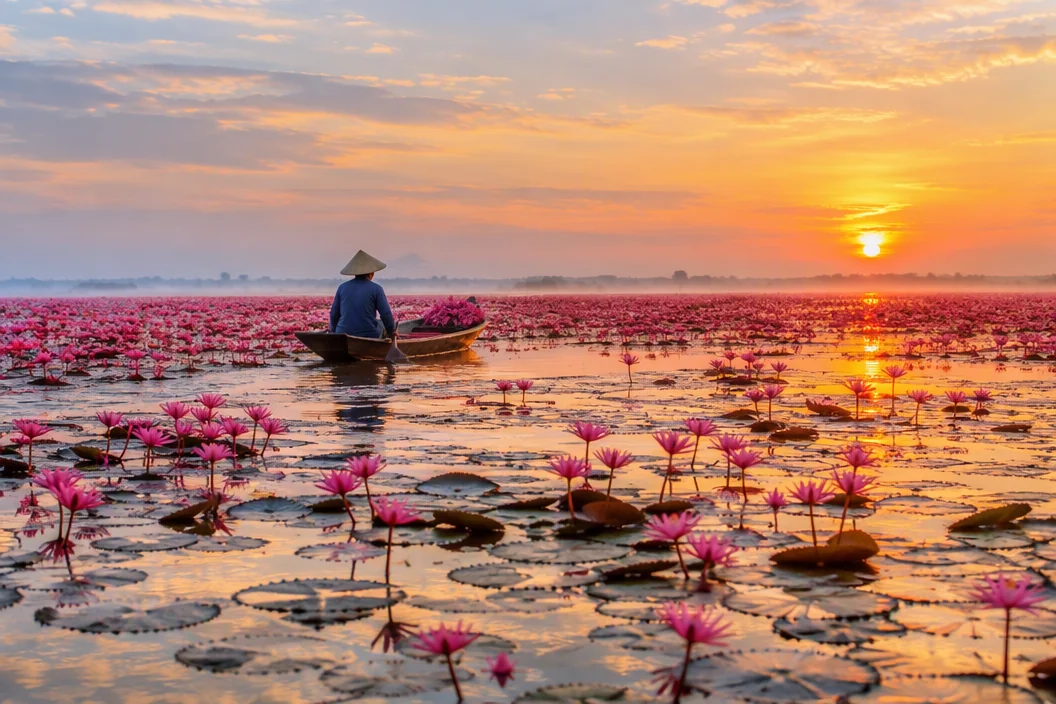
Situated in northern Isaan, Udon Thani combines rich historical heritage with one of Thailand’s most photogenic natural phenomena: the Red Lotus Sea (Talay Bua Daeng / ทะเลบัวแดง) on Lake Nong Han Kumphawapi. Between late November and February, millions of crimson-pink lotus blossoms burst into full bloom across the vast, 28,000-acre freshwater lake. Hiring a local wooden longtail boat at sunrise (06:00 to 09:00 AM) allows travelers to glide silently through open water channels surrounded by endless fields of floating pink petals and graceful migratory waterbirds.
Udon Thani is also home to Ban Chiang Archaeological Site, a UNESCO World Heritage site showcasing prehistoric human settlements, bronze metallurgy, and iconic red-painted swirl ceramics dating back more than 3,500 years.
4. Ubon Ratchathani: The Grand Canyon of the Mekong
Perched in the easternmost corner of the country, where Thailand meets Laos and Cambodia, Ubon Ratchathani is an outdoor adventurer's paradise:
- Sam Phan Bok (สามพันโบก): Known as the "Grand Canyon of Thailand," this dramatic geological marvel consists of more than 3,000 sandstone basins, rock pools, and labyrinthine craters carved into the Mekong River bedrock by millions of years of swirling whirlpool erosion. Visible only during the dry season (December through May) when water levels recede, visiting at sunset offers unforgettable otherworldly photography.
- Pha Taem National Park: Towering sandstone cliffs rise sheer above the Mekong River, offering panoramic views into rural Laos. A cliffside walking trail showcases prehistoric rock art panels painted with red ochre dating back 3,000 years, depicting ancient fishermen, giant catfish, wild animals, and human figures.
- Wat Sirindhorn Wararam (The Glowing Temple): Located near the Chong Mek border crossing, this hilltop temple features a magnificent Bodhi tree mural painted with phosphorescent pigments on the back of its ordination hall, which glows in radiant neon green against the night sky after dusk.
5. Loei & Nong Khai: Misty Mountains & Mekong Mysticism
- Chiang Khan (Loei): A tranquil riverside town lined with century-old teak wooden shophouses along the Mekong River. Visitors rent bicycles, offer morning alms of sticky rice to walking monks, and stroll the evening walking street sampling grilled river shrimp skewers and sweet banana pancakes.
- Phu Kradueng National Park (Loei): A legendary rite of passage for Thai hikers, this bell-shaped sandstone plateau requires climbing 5.5 kilometers through tropical forest to reach a cool, pine-scented highland plateau teeming with wildflowers, cliffs, and wild deer.
- Sala Keoku (Wat Khaek, Nong Khai): An awe-inspiring, surreal sculpture park created by mystic visionary Luang Pu Bunleua Sulilat. Towering concrete sculptures rising up to 25 meters depict complex narratives from Hindu and Buddhist mythologies, including a colossal seven-headed Naga protecting the seated Buddha.
A Culinary Adventure: The Legendary Food of Isaan 🌶️🍗
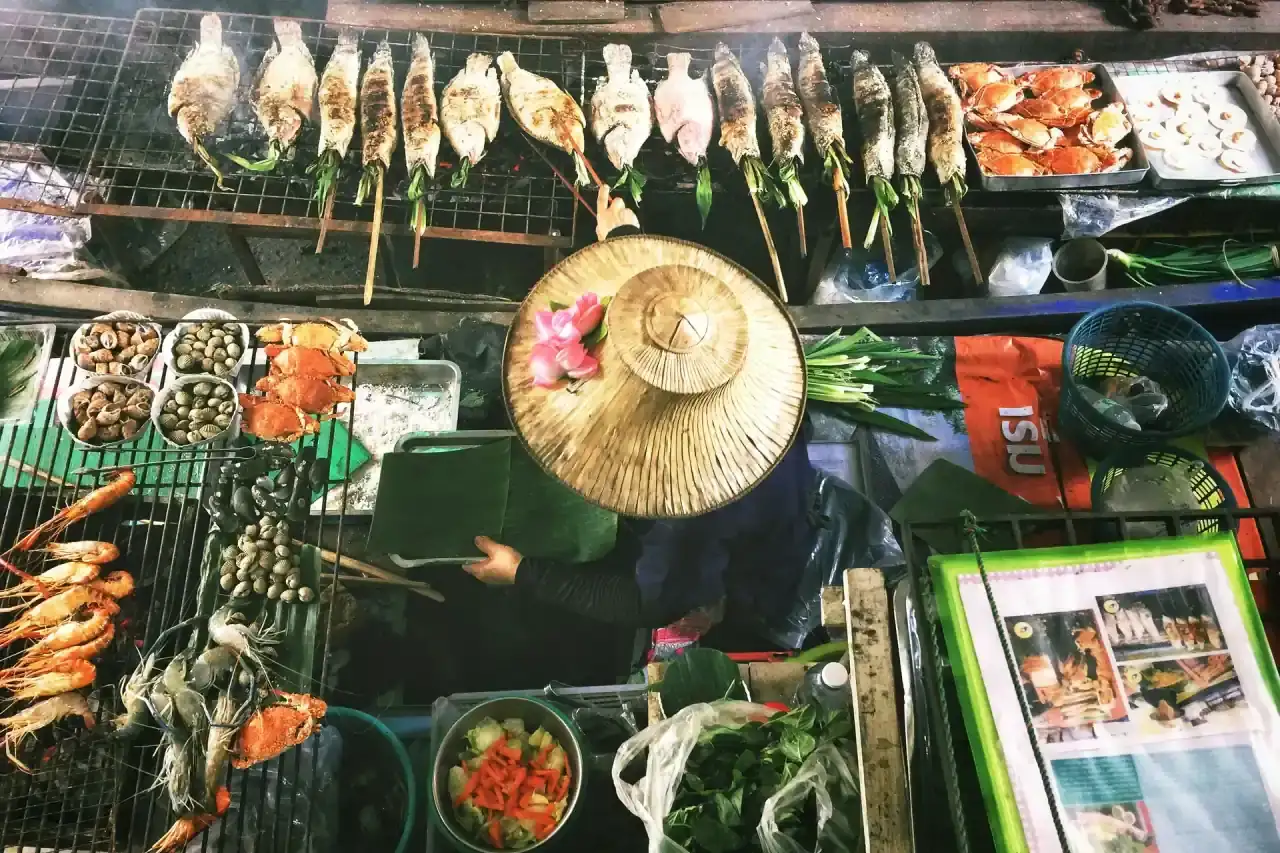
Isaan cuisine is widely regarded by culinary scholars and locals as the boldest and most flavor-packed regional cooking in Thailand. Unlike Central Thai cuisine, which relies heavily on creamy coconut milk and refined palm sugar, authentic Isaan food is pungent, intensely herbaceous, fiercely sour, and delightfully fiery. It is designed to be eaten communally, using your fingers to tear off balls of steaming sticky rice to scoop up rich juices. To understand how it contrasts with Bangkok street dining, read our Chinatown Food Guide.
🍽️ The Must-Eat Isaan Dishes:
- Som Tum (ส้มตำ): The crown jewel of Isaan cuisine. Green papaya pounded vigorously in a clay mortar with bird’s eye chilies, garlic, lime juice, tomatoes, and long beans. While Bangkok favors Som Tum Thai (with roasted peanuts and dried shrimp), locals in Isaan savor Som Tum Pu Pla Ra, featuring pungent fermented fish sauce (Padaek) and salted field crabs that deliver an electrifying umami depth.
- Gai Yang (ไก่ย่าง): Charcoal-grilled chicken marinated with crushed lemongrass, black pepper, garlic, coriander roots, and fish sauce. The town of Khao Suan Kwang in Khon Kaen is nationally famous for its free-range chicken, roasted over charcoal until the skin is paper-thin and crispy while the meat remains succulent.
- Larb & Nam Tok (ลาบ และ น้ำตก): Savory salads prepared with minced pork, beef, duck, or chicken (Larb) or sliced grilled meat (Nam Tok), tossed with toasted ground sticky rice powder (Khao Khua), fresh mint, sliced shallots, saw-tooth coriander, dried chili flakes, and fresh lime juice.
- Sai Krok Isaan (ไส้กรอกอีสาน): Fermented pork sausages packed with ground pork, garlic, and cooked sticky rice. Allowed to ferment naturally in the tropical heat for one to two days before grilling over charcoal, they deliver a signature tart, garlicky snap that pairs perfectly with raw cabbage and fresh bird's eye chilies.
- Tom Saep (ต้มแซ่บ): A blazing hot and sour clear soup simmered with pork ribs or tender offal, heavily flavored with fresh galangal, bruised lemongrass stalks, kaffir lime leaves, roasted chili powder, and holy basil.
Logistics & Practical Advice for Traveling in Northeastern Thailand
🗓️ Best Seasons to Visit Isaan:
- Cool & Dry Season (November – February): The absolute best time for travel. Daytime temperatures hover around a pleasant 26–30°C, nights in northern valleys can dip to a brisk 12–16°C, and skies are crystal clear. Lotus flowers at the Red Lotus Sea are in full blossom.
- Hot Season (March – May): Temperatures frequently exceed 38–40°C. While hot, this season hosts the exhilarating Songkran water festival and colorful Bun Bang Fai (Rocket Festivals) across Yasothon and Kalasin.
- Green / Rainy Season (June – October): Monsoon rains transform the plateau into an emerald paradise. Rice terraces and waterfalls are at their most breathtaking, tourist crowds are non-existent, and rain typically falls in short, predictable late-afternoon bursts.
Transportation: Getting There and Getting Around
- Domestic Flights: Low-cost airlines (AirAsia, Nok Air, Thai Lion Air) operate multiple daily 1-hour flights from Bangkok’s Don Mueang (DMK) and Suvarnabhumi (BKK) airports to major Isaan hubs: Udon Thani (UTH), Ubon Ratchathani (UBP), Khon Kaen (KKC), Buriram (BFV), and Nakhon Phanom (KOP).
- State Railway of Thailand (SRT): Taking the overnight sleeper train from Bangkok’s Krung Thep Aphiwat Central Terminal to Ubon Ratchathani or Nong Khai is a comfortable, scenic, and nostalgic journey through rural heartlands.
- Rental Car (Highly Recommended): Because many ancient Khmer temples and national parks are located in rural districts far from city centers, renting a modern GPS-equipped vehicle at airport hubs provides ultimate flexibility. Roads across Isaan are broad, well-paved, and encounter far less traffic than Bangkok.
Cultural Etiquette & Local Customs in Isaan
- Embrace the Spirit of 'Jai Yen' (A Cool Heart): Rural hospitality is sincere and unhurried. When communicating across language barriers, maintain a friendly smile and patience. Raising your voice or displaying anger is considered deeply impolite.
- Temple Dress Codes: When visiting sacred sites like Wat Phra That Phanom or Prasat Hin Phimai, ensure shoulders and knees are fully covered. Always remove your shoes before stepping onto temple hall carpets.
- Dining Etiquette with Sticky Rice: Sticky rice is meant to be eaten with your clean right hand. Pinch a small clump, roll it gently into a small ball between your fingers, and use it to scoop up meat, relish, or salad.
Frequently Asked Questions (FAQ) for Your Northeastern Thailand Trip
คำถามที่พบบ่อยและข้อมูลสำคัญที่คุณควรรู้ รวบรวมโดยผู้เชี่ยวชาญท้องถิ่น
Q1 Is Northeastern Thailand (Isaan) safe for solo and international travelers?
Isaan is one of the safest regions in Southeast Asia. Violent crime against visitors is exceptionally rare, and the local population is famously warm, welcoming, and hospitable toward foreign guests. As with all travels, exercise basic common sense: monitor personal belongings in busy bus terminals, drink bottled water, and take care when driving on rural roads after dark.
Q2 How many days do I need for a satisfying Isaan itinerary?
Because Isaan is so geographically expansive, budget at least 5 to 7 days for a focused regional circuit (for example, exploring Korat, Buriram, and Ubon Ratchathani in Lower Isaan, or Udon Thani, Nong Khai, and Loei along the Upper Mekong). A comprehensive 10 to 14 day road trip allows you to comfortably connect the southern Khmer temple ruins with the northern Mekong river valleys.
Q3 Can I travel around Isaan without speaking Thai?
Yes. While English is less widely spoken outside major city hotels and airport car rental desks, traveling without Thai is entirely feasible thanks to modern smartphone translation apps and offline Google Maps. Locals are extraordinarily helpful and will happily use gestures and smiles to assist you. Learning a few polite phrases—such as Sawatdee Khrap/Kha (Hello), Khop Khun (Thank you), and Mai Phet (Not spicy)—will delight your hosts.
Q4 What is the best month to see the Red Lotus Sea in Udon Thani?
The optimal time to witness the Red Lotus Sea in full glory is from mid-December through early February. Blooms open in the morning and begin closing under direct sunlight by 10:30 AM, so schedule your wooden boat tour between 06:00 AM and 08:30 AM for breathtaking photography and comfortable morning temperatures.
Q5 How do I witness the solar alignment phenomenon at Phanom Rung?
The sun aligns perfectly through all 15 doorways of Phanom Rung Historical Park four times annually: two sunrise alignments (typically early April and early September) and two sunset alignments (early March and early October). Thousands of pilgrims and photographers gather at the temple during these dates, so reserve Buriram accommodations several months in advance.
Q6 What is the difference between Isaan food and Central Thai food?
Central Thai cuisine (popular in Bangkok) balances sweet, salty, sour, and creamy elements, frequently utilizing rich coconut milk, palm sugar, and mild curries. In contrast, Isaan cuisine skips coconut milk and sugar in favor of intense umami derived from fermented fish paste (Pla Ra), searing chili heat, toasted sticky rice powder, fresh herbal aromatics, and tart lime juice.
Q7 Should I rent a car or take public buses in Isaan?
If your budget permits, renting a car at Udon Thani, Khon Kaen, or Ubon Ratchathani airports is strongly recommended. Many premier highlights—such as Sam Phan Bok, Pha Taem National Park, and Phanom Rung—are located 40 to 90 kilometers away from public bus routes. For city-to-city travel, Nakhonchai Air operates luxury, air-conditioned VIP coaches that are punctual and very comfortable.
Q8 Are there vegetarian options available in rural Isaan?
While traditional Isaan cooking celebrates pork, chicken, beef, and river fish, vegetarian dining is accessible. You can request dishes to be cooked Je (vegetarian Buddhist style) or Mangsawirat (vegetarian). Order Som Tum Thai Mai Sai Goong Haeng (Papaya salad with no dried shrimp and no fish sauce, using salt and soy sauce instead), fried tofu, sticky rice, and stir-fried morning glory.
Q9 What festivals in Isaan are worth planning a trip around?
Three unique world-class festivals highlight Isaan's calendar:
- Phi Ta Khon (Ghost Festival) in Dan Sai, Loei: Held in June or July, featuring colorful spirit masks crafted from coconut bark and colorful rice husks.
- Bun Bang Fai (Rocket Festival) in Yasothon: Held in May, where colossal homemade bamboo and PVC rockets are launched into the clouds to petition the gods for monsoon rains.
- Ubon Ratchathani Candle Festival: Held in July at the start of Buddhist Lent, featuring monumental, hand-carved beeswax floats paraded through the city.
Q10 Can I cross into Laos from Northeastern Thailand?
Yes. Isaan features several official international border crossings equipped with Laos Visa-on-Arrival facilities:
- First Thai-Lao Friendship Bridge (Nong Khai to Vientiane): The most popular crossing, located just 20 kilometers from Laos’ capital city.
- Second Friendship Bridge (Mukdahan to Savannakhet): Convenient for connecting into Southern Laos.
- Chong Mek Crossing (Ubon Ratchathani to Pakse): Ideal for travelers heading toward the Bolaven Plateau and Wat Phou Khmer temple.


.webp&w=1920&q=75)
.webp&w=1920&q=75)